
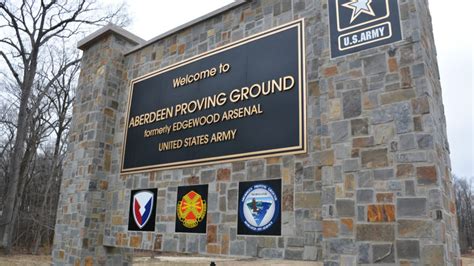
I’ll help you create a blog post about Aberdeen Proving Ground using the specified guidelines. I’ll first do a web search to gather accurate information. Based on the search results, I’ll craft the blog post following the specified guidelines:
Aberdeen Proving Ground stands as a testament to American military innovation, nestled along the picturesque Chesapeake Bay in Maryland. Established on October 20, 1917, this remarkable military installation has been a cornerstone of technological advancement and national defense for over a century. The facility emerged during a critical moment in American history, just six months after the United States entered World War I, with a specific mission to revolutionize military testing and research.
A Strategic Military Landmark

The location of Aberdeen Proving Ground (APG) was carefully selected by Colonel Colden Ruggles, who sought a site that balanced proximity to industrial centers while maintaining safe distances for extensive munitions testing. The chosen area was previously fertile farmland, home to approximately 3,000 residents who were compensated and relocated through an Act of Congress and presidential proclamations. This 72,000-acre installation quickly became a hub of military innovation.
Pioneering Technological Breakthroughs

Throughout its history, APG has been responsible for numerous groundbreaking developments:
- Invention of the Bazooka: During the early days of World War II, engineers solved the critical challenge of defeating German tank armor by developing a rocket-propelled grenade launcher.
- First Digital Computer: The ENIAC (Electronic Numerical Integrator and Calculator) was created at APG, marking a pivotal moment in computational history.
- Advanced Weapons Testing: The facility conducted proof-testing of field artillery weapons, ammunition, trench mortars, air defense guns, and railway artillery.
Evolving Mission and Impact

The proving ground has continuously adapted to national defense needs. During World War II, APG expanded significantly, establishing critical facilities like the Ordnance Museum, Ordnance Specialist School, and Ballistic Research Laboratory. By the 1950s and 1960s, the installation had broadened its focus to include electronic computing, space studies, and satellite tracking.
Modern-Day Significance

Today, Aberdeen Proving Ground remains a crucial center for military research and development. It hosts several key organizations:
- U.S. Army Research, Development and Engineering Command
- U.S. Army Test & Evaluation Command
- U.S. Army Chemical Materials Agency
- U.S. Army Medical Research Institute of Chemical Defense
🔬 Note: APG currently employs more than 18,000 civilians and soldiers, making it Harford County's largest employer and a significant economic driver for Maryland.
A Legacy of Innovation

From its humble beginnings as a munitions testing site to its current status as a cutting-edge research facility, Aberdeen Proving Ground exemplifies the United States military’s commitment to technological innovation and national security. The installation continues to play a critical role in developing technologies that protect and advance national interests.
When was Aberdeen Proving Ground established?

+
Aberdeen Proving Ground was established on October 20, 1917, six months after the United States entered World War I.
What significant inventions came from APG?
+
Notable inventions include the Bazooka, the ENIAC (first digital computer), and numerous advancements in weapons testing and military technology.
How large is Aberdeen Proving Ground?

+
The installation covers approximately 72,000 acres along the Chesapeake Bay, making it a substantial military research facility.
